Just a few short years ago, the historic heart of Overtown, Miami’s original Black neighborhood, lay desolate and lifeless just steps from Biscayne Boulevard and downtown. There were few if any shops, few homes, not a single grocery store, but lots of vacant lots, the result of decades of demolition, disinvestment and abandonment.
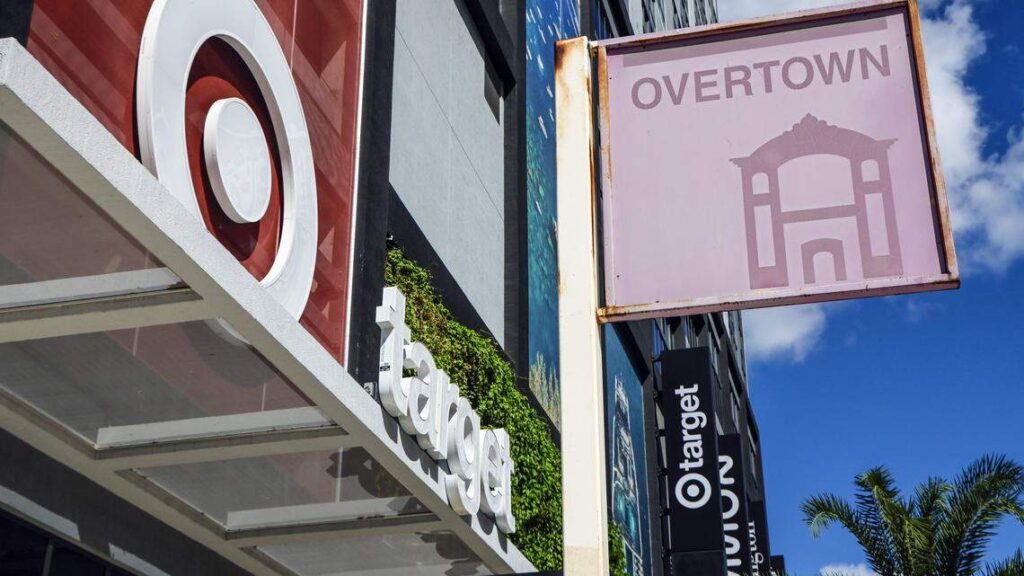
Today, the change along the six blocks of Northwest Second Avenue and its immediate vicinity is nothing short of dramatic. The streets are busy with pedestrians, thanks to a few thousand new and renovated apartments, both market-rate and affordable, within a few square blocks. There’s not only a new Publix, but also an Aldi, a Ross, a Target with a CVS and a Starbucks in a towering complex that also includes 578 stylish apartments for low-income seniors, many of them longtime Overtown residents.
The resurgence is driven, perhaps ironically, by what some would describe as gentrification: the millions of dollars in tax revenue generated by a decade of massive new construction across the Florida East Coast Railway tracks — once the boundary of the official racial segregation line that created Overtown in the first place.
The redevelopment has brought thousands of luxury apartments, condos and upscale shops to the Boulevard, facing Maurice A. Ferre Park and its two museums, and to the adjacent multi-block, multi-tower Miami World Center district, which is approaching buildout after more than a decade of constant construction.
And it’s about to further turbocharge Overtown’s comeback.
 The Southeast Overtown/Park West Community Redevelopment Agency, an arm of Miami city government, has won commission approval for a new, roughly $175 million bond program that’s supported by the property-tax revenue flow from new development in the district, which stretches from the west side of Biscayne Boulevard to west of Interstate 95. Over the next several years, the program is expected to help finance some 2,500 new affordable and workforce homes and apartments in greater Overtown, new and improved parks and cultural facilities, and significant assistance to local business owners.
The plan includes a $25 million conversion of the notorious former women’s jail across the street from Booker T. Washington Senior High into an art and cultural center, a complete $15 million revamp of the pedestrian Ninth Street Mall with a new design by renown landscape architect Walter Hood, winner of a MacArthur “genius” award, and significant contributions toward a full redevelopment of two obsolescent Miami-Dade County public housing projects that will convert them into mixed-income, mixed-use communities with nearly 800 new apartments.
If all goes according to plan, the bonds could also help finally bring to life a long-dormant plan to create a live music and entertainment hub along Second Avenue that would harken back to Overtown’s heyday, when it was known as Little Broadway for its profusion of jazz and soul music clubs. One lofty goal: re-creation of the long-vanished Harlem Square Club, where in 1963 soul star Sam Cooke recorded what’s widely regarded as one of the best live albums ever.
One small piece of Overtown’s planned cultural revival has been finished. The agency renovated the long, one-story building that housed prominent Overtown attorney Lawson E. Thomas’ office, converting it into an exhibition space, with a total project cost of $374,000. The inaugural exhibit, “Color Town,” consisting of remarkable photographs of Overtown daily life in 1947 by New York photographer Max Waldman, is up now.
“What we’re seeing now is a renaissance of this community that was so rich in history and culture,” said Miami Commission Chair Christine King, who represents Overtown and also presides over the city commission when it sits as the Overtown CRA board. “All that is coming back.”
 However, one major project, a new 33-acre park to be installed under the rebuilt Interstate 395 span that cuts through Overtown, has hit a significant roadblock. The Trump administration rescinded a $60 million grant to the city for the project, dubbed The Underdeck, under a program designed to ameliorate the devastating effects of highway construction on communities like Overtown. The CRA would have contributed an additional $3.5 million for the park project, which is at a standstill.
The goal of the CRA, one of Overtown’s largest landowners, is ambitious: to repopulate the historic neighborhood and restore the local economy.
Overtown at its peak had some 30,000 residents, ranging from laborers to teachers, doctors and millionaire entrepreneurs, before it was drained of its population and social and economic vitality by the construction of Interstate 95, which evicted thousands, and the end of legal segregation, which prompted many others to depart, leaving behind the poorest of the poor. By the time one of the first new apartment buildings on Second Avenue, the Plaza at the Lyric, opened in 2016, Overtown was down to a mere 8,000 residents with a median household income of just around $30,000, one of the lowest in Miami-Dade.
Countering the trend, says CRA director James McQueen, requires drawing new residents at a range of incomes. Market-rate apartments and workforce housing can attract professionals and middle-class workers such as first responders, teachers and health-care staff. Affordable housing, usually backed by federal, state and local subsidies, provides a chance for Overtown residents to remain in the neighborhood, while — or so the hope is — bringing back the children and grandchildren of those who left, in particular the younger working generation.
“That starts to return population to an area that once had 30,000 residents,” McQueen said. “It helps the churches. It helps the restaurants. It helps everybody. We are trying to give people a new neighborhood to come into.”
 That new neighborhood will be a very different Overtown, to be sure — less African American and Bahamian and more Hispanic, and physically far denser and taller. The new Atlantic Square mixed-use tower, for example, rises more than 30 stories, thanks in part to the county’s generous rapid-transit zoning rules. But the new projects are also designed to keep alive the neighborhood’s history and cultural legacy as a vital part of the city its original residents helped build, King and McQueen say.
“This bond is going to make a tremendous difference in the lives of Overtown residents,” King said, using the nickname those born or bred in the neighborhood apply to themselves “Now these Towners are able to take advantage and be a part of this renaissance. They never gave up on it. For every development that comes in, we take a piece to preserve the community.”
This success has come relatively late in the CRA’s life. For decades after it was launched in 1982, because little new development happened within its borders, the agency had scant money to invest and came under regular fire for lack of results. Presciently, however, city leaders had included the largely derelict Park West district in the agency’s jurisdiction.
Squeezed between Biscayne Boulevard and the FEC tracks, Park West was a warehouse district serving the Port of Miami when ships docked at what is now Ferre Park. When the port moved to Dodge Island, Park West gradually fell into disuse and dilapidation. But then-Commissioner Arthur Teele foresaw Park West’s prime location as a locus for future development that could feed the revival of Overtown across the tracks, King recalled
It took decades, but eventually the big dollars began flowing into CRA coffers. Under the financial formula for the agency, known as tax increment financing, or TIF, a portion of property taxes from new construction in a defined district characterized by poverty and blight flows to the agency for use in economic and housing development. The first significant revenue came from new mixed-use towers on Biscayne.
But the major linchpin has been development of Miami World Center, which itself took about a decade after its unveiling to break ground. CRA financing helped make World Center possible. The agency invested $23.9 million, in the form of tax rebates, in helping build all-new infrastructure — the water and sewer lines, power connections, streets and sidewalks — that underlie the mega-development.
The agency has also provided substantial financial support to other key infrastructure improvements in the neighborhood, including $17.5 million towards the Tri-Rail commuter train link to Brightline’s Miami Central Station.
 The new bond issue, based on how much the agency can repay buyers by the time of its mandated end in 2042, far outstrips the agency’s previous one, which raised some $60 million. A portion of the new program, around $23 million, will go to pay off old debt at favorable terms, saving the agency money that can be directed to new endeavors, McQueen said.
The agency stretches those dollars by collaborating with nonprofit developers and groups and for-profit developers specializing in affordable housing who cobble together CRA funding, federal and state tax incentives and private investment to build. The CRA often also provides land at deep discounts or, in the case of nonprofits, for free.
While the CRA contributions are often just a piece of the financing structure for the bigger residential developments, its money and land help defray costs — a key piece in allowing developers to charge rents affordable to people with low and even very low incomes.
Some of the initiatives to be funded by the new bonds include projects now underway or recently completed, as well as several that will soon break ground. According to the CRA, these are some of those projects:
* Atlantic Square, which recently opened, brings 616 apartments to a Miami-Dade County-owned lot on Northwest Second and Eighth Street, with 60 percent to be rented at affordable and workforce rates. The CRA invested $10 million in the project, formerly known as Atlantic Station, by Atlantic Pacific Companies, a major affordable-housing developer.
* Atlantic Pacific is also redeveloping two Overtown county public housing projects, Culmer Place and Culmer Gardens, with some 779 mixed-income units, including 599 affordable housing units. The CRA contribution totals $15 million for both.
* A collaboration between developers Coral Rock with a nonprofit offshoot of the historic St. Agnes Episcopal Church in Overtown will produce 160 affordable units on Northwest Third Avenue. The CRA deeded land worth $70 million to the church nonprofit and is investing $15 million in the project.
* Rainbow Village, a full redevelopment of a public housing project with the same name, will encompass 310 affordable and workforce units, a community center and retail space. The CRA is contributing $15 million to the project, to be built by affordable-housing developer Housing Trust Group.
* The CRA is contributing $15 million towards construction of a 300-space, eight-story Miami Parking Authority garage that will serve the planned entertainment district.
* The CRA will also put $10 million into the nonprofit Girl Power Rocks, Inc, for its Mama Hattie’s House Social, Educational & Recreational Complex project. It will provide “safe space” for young women aging out of foster care and girls at risk of trafficking and abuse.