CLIENT NEWS: Billionaire’s $20 million gift kickstarts Vizcaya expansion
November 13, 2025As the landmark, publicly owned Vizcaya Museum and Gardens starts work on an extensive, long-planned restoration and enhancement of the estate’s historic farm village, the initiative has lured a large gift from billionaire Ken Griffin — and a surprising proposition from the financier that’s sure to draw significant scrutiny.
On Friday, Vizcaya’s leaders are set to unveil a revised, detailed master plan for a revamped farm village along with a $20 million donation to the project from Griffin, the founder of the Citadel financial empire whose 2022 move to Miami has been accompanied by a real-estate acquisition spree and about $300 million in gifts to numerous South Florida civic causes and initiatives.
The 12-acre farm village, located across South Miami Avenue in Coconut Grove from the vast, opulent Vizcaya villa and its elaborate gardens, produced the food to nourish industrialist James Deering’s houseguests and staff at a time — the 1910s and early 1920s — when Miami was little more than a rustic outpost.
Vizcaya’s long-term plan for the site calls for, among other ambitious goals, converting picturesque buildings that once housed chickens, a dairy and stables into public spaces for exhibits, art and conservation studios, seminars, a research library, archives and other public uses. It also would create a new farm field, greenhouses and expanded facilities for urban agriculture, a teaching kitchen, Vizcaya’s popular Sunday farmer’s market, and other community activities.
The goal: to turn the underused village site into a new community cultural, arts and food hub that visitors and Miamians can regularly enjoy on its own, without the need to visit the main house, something locals may do only occasionally.
But there’s a twist.
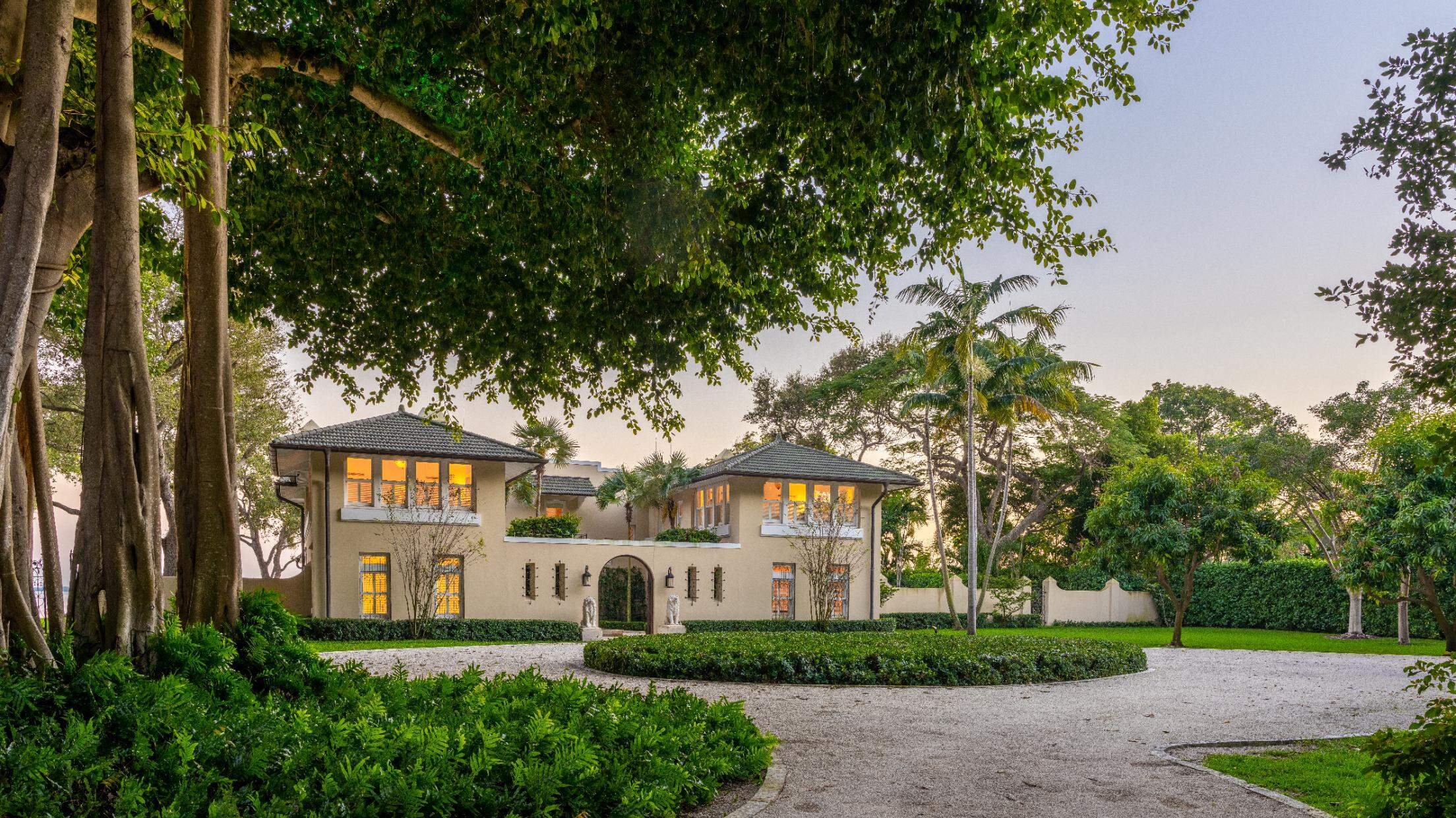
Vizcaya’s newest version of the plan incorporates a previously undisclosed proposal from Griffin to move one of Miami’s most important historic homes — three-time Democratic presidential candidate William Jennings Bryan’s Villa Serena — from his nearby bayfront estate to the farm village.
Griffin has been quietly trying to find someone to take Bryan’s 1913 Mediterranean home off his hands since he acquired banker Adrienne Arsht’s estate, on which Villa Serena is located, for nearly $107 million in 2022. Arsht had meticulously renovated the two-story Villa Serena in 2008 for use by guests while building a new, larger mansion for herself next door on the expansive property, which sits three doors over from the palatial Vizcaya manor at the quiet, lushly sequestered south end of Brickell Avenue in Coconut Grove.
A previous, secretive inquiry by Griffin over offloading the house to a city of Miami anti-poverty agency provoked an uproar from preservationists and historians that seemed to help quash that idea, in part because a significant element in its historic value is its location on a limestone bluff overlooking Biscayne Bay where Bryan, a renown Christian orator, would speak to dozens of gathered Miamians on Sundays.
The home’s setting behind a gravel drive, gated limestone wall and garden and the expansive bay views from its interior are also essential features, said Miami preservation architect Richard Heisenbottle, who oversaw the restoration for Arsht and has also worked extensively for Vizcaya, including on preliminary plans for the farm village.
While saying he applauds Griffin for making an unrestricted gift of “very, very serious funds” to Vizcaya, which has at times struggled to raise money for even basic repairs, Heisenbottle questioned the proposed move. Without its natural surroundings, he suggested, Villa Serena risks losing much of what makes it unique.
“There is a sense of place here that transcends the house that is really part and parcel of this house. The backyard is really important. This is much more than just a historic house,” Heisenbottle, who was shown the plan and asked to comment publicly by Vizcaya officials.
“So we have to ask some serious questions,” he said in an interview. “Do we diminish the importance of Villa Serena by taking it out of its context? Does it become just another old house?”
Another preservationist consulted by the museum’s leaders on the proposal says that, though not ideal, moving the house under Vizcaya’s stewardship is an acceptable compromise given that Griffin seems determined to get Villa Serena off his property and has pledged to fund the full cost of moving and restoration.
One advantage of a move, they say, is that the historic home, now privately owned and off-limits to visitors, would become property of Miami-Dade County and, as part of Vizcaya’s farm village plan, could be a showcase for the history of early Miami settlers, for Bryan and for architectural preservation conducted under high standards.
“Under no circumstances is moving a building the best option for its long-term preservation,” said noted art and architectural conservator Rosa Lowinger. “South Florida is notorious for powerful people demolishing historic buildings, and we have lost so much that way. But the Vizcaya plan is extremely conscientious in the way it will take the house.
“I understand people will say this one is moving because a rich man bought it and wants it moved. But we’re not dealing with an individual who is threatening to bulldoze it. He will be able to fund a project that could set a national standard. And I think that’s commendable,” Lowinger said.
Vizcaya’s leaders stress that Griffin’s $20 million gift is not conditioned on the separate VIlla Serena proposal, which requires approval from Miami-Dade County, the city of Miami and other authorities. Griffin would cover the full cost of the move, which has not been specified, and provide an additional $5 million endowment for its upkeep and maintenance at Vizcaya.
“We have definitely given it a lot of serious thought,” said longtime Vizcaya executive director Joel Hoffman. “We do believe Vizcaya as a publicly owned entity is an appropriate setting to explore the story of William Jennings Bryan.
“I am well aware and respect the process to consider this request, and we understand strict historic preservation guidance is to keep a historic building where it is. But on the present site no one sees it. Here it will be seen by our 400,000 annual visitors.”
Miami-Dade Commissioner Raquel Regalado, whose district includes Vizcaya and who has been a leading voice on the commission for the farm village project, said she supports the Villa Serena move and will introduce an amendment to the site master plan for approval by her colleagues.
She noted that the story of Villa Serena and Bryan was one of public access and community gatherings, and its placement in Vizcaya would be true to its history — and a contrast to the private, invitation-only early days of Deering’s estate.
“It’s a different vibe,” Regalado said. “It brings a very different story to Vizcaya, one of public engagement and advocacy which will be something that future generations can explore.”
The farm village plan would place Villa Serena, which though elegant in design covers only a modest footprint, in a prominent spot near the site’s eastern edge along South Miami Avenue. The plan calls for extensive planting of palms and flowering native trees and plants around it, as Bryan had it, Hoffman said. Specific uses for the house have yet to be determined, he said, though it’s ample enough to host exhibits, tours, small meetings and events.
Vizcaya, owned and subsidized by Miami-Dade and managed by a nonprofit group called Vizcaya Museum and Gardens Trust, Inc., has been working on the farm village plan since about 2015, when the Miami Science Museum and Planetarium, built on the site in 1960, vacated its building in preparation for a move downtown and a new identity as Frost Science.
The relocated Villa Serena, the farm field and other planned new facilities would occupy the site of the demolished science museum and its 128-space surface parking lot. Parking will move to a planned new three-story deck at the rear of the site along U.S. 1.
Friday’s announcements also marks the launch of an ambitious fundraising program for the farm village plan. While the Vizcaya trust does not yet have a precise budget for the project, it’s expected to cost “upwards” of $100 million, Hoffman said.
“For us, this is an incredibly important moment,” Hoffman said in an interview, alluding to Griffin’s gift. “This donation can really help motivate our community to stand behind this extraordinary asset.”
Some initial elements of the plan have already been completed, including an extensive restoration of the former Vizcaya superintendent’s house, which now houses staff offices and a new cafe. A buffer of pine trees like those that once covered the site was planted on the south flank of the site to shield the Bay Heights residential subdivision, once a part of the Vizcaya farm. The car barn was renovated years ago and is used for public meetings, but is slated to receive another refurbishing eventually.
Next up is renovation and conversion of four other original buildings that form a quadrangle, including a quaintly detailed former chicken house with egg-shaped windows and the old dairy barn, topped by a weathervane that has a cow jumping over the moon, into Vizcaya’s new Center for Learning and Discovery. That work has already begun and should be done by the end of 2026.
After that will come improvements along South Miami Avenue, including the potential site for Villa Serena, followed by landscaping and renovation of small auxiliary buildings on the north side of the farm village and the start of work on “The Field” to allow expansion of its urban agriculture programs.
The Miami-Dade commission approved the original farm village master plan in 2017, but will have to vote again to consider the potential addition of Villa Serena. Because the villa is a protected as a historic landmark by the city of Miami, its historic preservation board would also have to approve the relocation plan as well.
Deering, Vizcaya’s builder, and Bryan were almost exact contemporaries and are believed to have had several encounters. Deering used Vizcaya exclusively as a winter escape, but by the 1920s Bryan had expanded Villa Serena to serve as his year-round residence, Heisenbottle said. Deering and Bryan died months apart in 1925.
It’s unclear what Griffin hopes to do with the property where the villa now stands, how much the house move would cost or precisely how the house would be moved. Conservator Lowinger and Vizcaya officials say the engineering, preservation and contracting team members Griffin has assembled to oversee and manage the proposed relocation have considerable experience and say the house can be safely moved the short distance to Vizcaya.
Lowinger, the conservator, said that the preservation consultants for Griffin identified by Vizcaya, Heritage Architectural Associates of Miami, are “top-notch.”
“They’ve hired people who really know what they’re doing,” Lowinger said.
In a brief statement provided by Vizcaya, Griffin said: “Vizcaya’s vision for a vibrant Village will connect Miami to its remarkable past and inspire what’s possible for its future/ Its expansion will bring history to life in new ways, sparking curiosity, creativity, and connection across our community. I’m proud to support an institution that reflects Miami’s spirit —its history, ambition, and enduring drive to create something extraordinary.”
Bryan, a renowned orator who ran three times unsuccessfully for the presidency, was a singular and complex figure in U.S. history.
Called “The Great Commoner” for his sympathy with working people, he was a Democrat and leader of the pro-labor Progressive Movement. He opposed American imperialism and championed what in his day were considered radical positions, including the eight-hour workday, a minimum wage, the right of unions to strike and women’s right to vote.
He served as secretary of state in the first two years of Woodrow Wilson’s first term as president, but, as a supporter of neutrality in World War I, resigned in 1915 when the president moved to intervene militarily in Europe. Jennings Bryan was at the same time a conservative Christian who advocated for Prohibition and led the fight against the teaching of evolution in public schools. In 1925, he famously represented prosecutors looking to fine a Tennessee teacher in the Scopes Trial for violating a prohibition against teaching Darwinism and won the case, only to collapse and die days later. That ruling was later overturned on appeal.
In a fact sheet provided by Vizcaya, the museum said it would make good use of Villa Serena:
“As South Florida’s best-known and most-visited historic house museum, Vizcaya is well prepared to preserve Villa Serena and interpret Bryan’s civic ideals and his complex views on imperialism and war, science and religion, and race relations.”