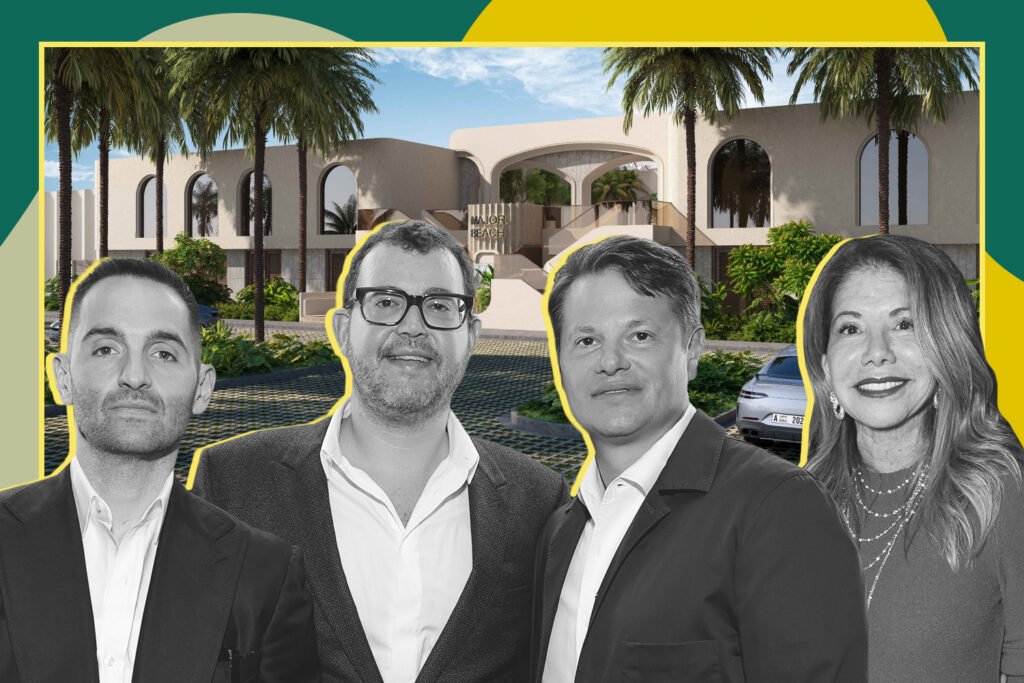
When real estate investment firm Rivani announced in August it would bring Playboy’s global corporate headquarters to Miami Beach, the team knew the news would make a splash. But no one was quite ready for how much attention it would bring. “[The reaction] was crazy. It was insane,” said Robert Rivani, the namesake founder and president of the company formerly known as Black Lion.
The news that Playboy had signed a 10-year lease for 20,000 square feet of penthouse space at Rivani’s flagship ultra-luxury office building in Miami Beach went mega-viral. Between traditional and social media, the news of the deal got more than a billion impressions, Rivani says, citing a tally by his company’s PR firm.
“We’d talked about it for so long internally, we almost forgot about how exciting it was,” Rivani CIO Patrick Khoury said.
It was the company’s biggest news to date, but certainly not the first time the developer had drawn notice from South Florida real estate insiders.
Since relocating from Los Angeles during the pandemic, Rivani has made a name for himself in Miami. He’s as known for his attention-grabbing transactions – multimillion-dollar cash deals in Brickell, record-breaking leases in Miami Beach – as he is for his distinctive physical appearance and unusually hands-on working style.
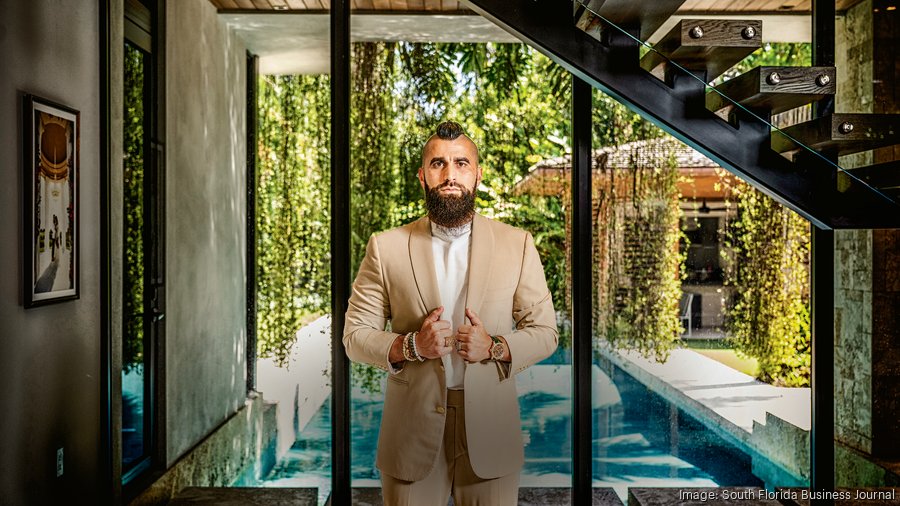
Rivani, 35, sports a mohawk, long beard and flashy jewelry. He has no partners or outside investors. His inner circle is intentionally kept small, and he rarely lets outsiders in. In short, he cuts a different figure from the typical Miami real estate developer.
“He’s an artist who happens to be in real estate,” is the best way Khoury has to describe him.
‘Why not me?’
Rivani was raised in a Persian Jewish immigrant family in Westwood, a neighborhood of L.A. sometimes known as ‘Tehrangeles’ for its large Iranian community.
“I grew up in a family of five in a 1,500-square-foot home, lower-to-middle income,” Rivani says. “Being a few blocks away from Beverly Hills … and asking, ‘Why not me?’”
Growing up, he was often referred to as the black sheep of the family because he looked and acted a certain way, he adds.
But, even as a kid, he discovered role models who gave him something to look up to, including professional basketball icon Michael Jordan.
“He was everything to me,” Rivani says. “How cutthroat he was, how motivational he was, how he always wanted to win. I had a very similar personality.”
After dropping out of high school, Rivani started sleeping outside of sneaker shops overnight to buy the latest Air Jordans. And after learning what the sneakers were reselling for on eBay, he had the idea for his first business.
“I just kept doing these overnight stays, and I’d make a couple hundred bucks [reselling] every shoe,” Rivani says.
What started out as a small venture would eventually become a shoe company that Rivani says was worth about “a quarter of a million dollars.”
The money was good, especially for a 16-year-old, but the lifestyle wasn’t sustainable. With his relatives’ encouragement, Rivani transitioned to the family business, property management.
He was still learning the ins and outs of real estate when the market crashed in 2008.
Rivani saw it as an opportunity to buy distressed properties at a steep discount, before re-leasing them to new tenants and flipping them for a neat profit.
Using the money he’d saved up from his sneaker venture, Rivani – not yet in his 20s – began snapping up properties in Atlanta, focusing on vacant or abandoned strip malls.
He made $1.5 million in the first two years, he says, and quickly expanded to other markets in Texas and the Midwest. Within a few years, he had become a major shopping center developer.
Still, it would take another national crisis for Rivani to become the entrepreneur he is today.
The Covid effect
When Los Angeles locked down in March 2020, it turned Rivani’s world upside down, both personally and professionally.
Stuck at home, Rivani’s wife, Krystal, began cutting his hair, giving him his now-signature mohawk-and-beard look. Then one day, a conversation with Krystal, a registered dietician and nutritionist by training, changed the trajectory of his career.
“My wife tells me, ‘I’m never going to go to shopping centers anymore, because I have Instacart, I have all these delivery apps,’” Rivani says. “So I’m thinking to myself: Being a shopping center developer … what’s the future?”
He began to think about pivoting to hospitality because “people are going to always want to go out. I don’t see that changing.”
But being in perpetual lockdown mode wasn’t for Rivani, so it didn’t take long for him to compare California’s strict policy to Florida’s less restrictive response to the pandemic.
“My wife and I and all of our friends in L.A. were like, ‘I can’t drink, can’t party, can’t go out, can’t get a haircut, can’t go to a restaurant in peace,’” Rivani remembers. “And our friends in South Florida were FaceTiming us, partying in broad daylight. And I’m like, ‘How is this possible?’
“That’s when I sold the better part of $100 million of the existing portfolio and said, ‘We’re going all in on South Florida.’”
Black Lion roars in Miami
Starting in late 2021, Rivani went on a tear, buying commercial condos in Miami and converting them into luxury spaces for big-name hospitality groups, like L.A.’s famed Delilah supper club.
He began attracting attention in South Florida – not just for his high-profile deals and distinctive appearance, but also for his working style.
“Robert is completely different than any other real estate developer that I’ve had experience with, in the fact that it is his own money – no investors, no partners,” Newmark broker Jeremy Hakala said. “Very, very few developers operate that way.”
Hakala, who represented the company in the Playboy deal, added that Rivani “operates his life as if he has everything to prove to everybody. And that’s what makes him him.”
Meanwhile, Krystal encouraged her husband to publicize his deals online more actively, something unusual for many commercial real estate developers.
Rivani started posting more on social media, often wearing T-shirts stamped with the profile of a lion wearing a crown. The design was a nod to the company’s name at the time – itself a reference to Rivani’s feeling as an outsider in his own family.
“I didn’t want to call my company Black Sheep Investment Group, so Black Lion just sounded better,” he quips.
In conversations with Rivani and those in his circle, Krystal’s name comes up again and again.
“His No. 1 advisor, hands down, without question, is Krystal. And a lot of people don’t know that about him,” Khoury says. “There’s absolutely nothing that happens in this company that isn’t [touched] by Krystal.”
Soho House for offices?
In April 2024, Rivani surprised observers by purchasing its first office building in Miami Beach for $62.5 million – and announcing plans to spend an additional $50 million to turn it into an ultra-luxury commercial space with hospitality-style amenities, a combination it dubbed Class X. (If approved, the building will house Playboy’s global headquarters.)
As for the company rebrand that followed more than a year later, Rivani said it was needed to enhance his personal brand and to underline the group’s expansion into office.
“A lot of people thought Black Lion was just a restaurant group,” Khoury says. “[Rebranding] was an opportunity for us to show the world what we’d been working toward.”
Looking ahead, Rivani plans to open a string of other Class X office-hospitality spaces across South Florida and the rest of the country, offering Soho House-style memberships across locations.
While declining to provide additional details, Rivani says he is now “actively looking every hour of every day” to expand the concept.
Can that really work, given how small of an inner circle Rivani keeps? And can he actually build an office empire without any outside investors or partners?
“With the current in-house team, definitely not,” he says.
Khoury, the CIO, agrees, adding that “once we get to a certain point where we’re just scaling so quickly, the opportunity will be there to have partners and to raise money.”
L.A. wildfires hit close to home
It’s been a year of big wins for Rivani, but also big losses.
Just months before negotiations on the Playboy deal began in earnest, a series of wildfires ripped through Southern California, torching a multimillion-dollar mansion Rivani was developing as a house flip.
Between the cost of the original home and extensive renovations, Rivani had put nearly $27 million into the project, and was planning to imminently list it for $40 million. He and his team were finalizing its staging when it all burned down.
The insurance payout didn’t come close to compensating the investment, and he lost $20 million, he says.
“I’ve seen Robert down, but maybe not to that level. It was tough to watch,” Newmark’s Hakala says.
It was a rough few days, he says, but after that, Rivani picked himself back up with a renewed focus on South Florida.
“I think a lot of people are intimidated by Robert’s desire to do something different,” Hakala says. ‘There’s naysayers out there. I think there’s probably people that want to see him fail. I would highly recommend those people not to wager on it.”